

The Companions You Don’t Know You’re Looking For
When you do the real work—the kind that asks you to sit with uncomfortable questions and actually implement what you learn—you become what people often call sorted.
They mean it as a compliment: You’re so together.
Underneath, it can feel like a fence. You’re on the other side now—admired from a distance—but no one is asking where the gate is.
The more work you do, the lonelier it gets.
Not because you’re better, but because you can’t unknow what you’ve learned about yourself. And most people don’t want to do the work it takes to meet you where you are.
For a long time, I thought something was wrong with me because I didn’t have deep, soulful friendships built on constant check-ins, intense processing, or multi-day girls’ trips.
But I’ve realized I was looking for the wrong thing.
What I actually need are companions on the path.
People who do their own internal work without needing me to carry it.
People who can sit with discomfort instead of rushing toward answers.
People who receive what’s offered without demanding more.
People who actively defy self-erasure—refusing to disappear just to keep things smooth.
These people are rare.
And when you find them, conversation isn’t always required. Sometimes it’s enough to be in the same room, each doing your own work, held by the quiet presence of others doing theirs.
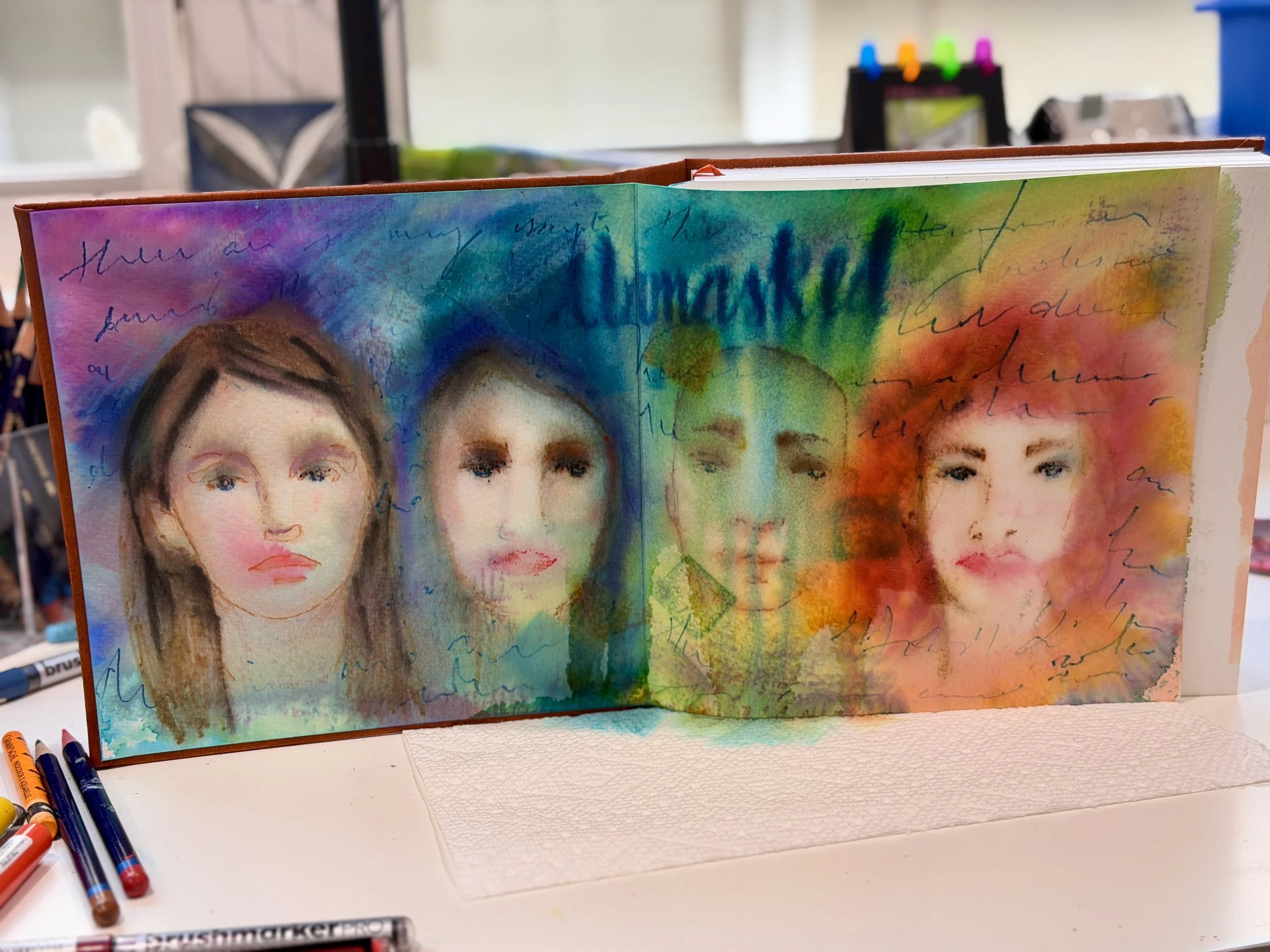
The journal page that emerged as a result of the conversations in the February Ripple Room where our theme was Self-Kindness
I spent years trying to build community through deep one-on-one connections. It was exhausting.
We’d bond quickly—often through a shared wound—and it would feel meaningful and intense. But over time, I’d realize there were no legs. Our shared brokenness was the glue, and once that dried, there was nothing else holding us together.
I also tried common ways of forging online community—comments, DMs, circles, Discord groups. But that wasn’t connection. It was keeping tabs. Watching each other’s lives from a distance and calling it closeness.
Real connection requires time. Energy. Presence.
Most people don’t have that to give—not because they’re unkind, but because they’re busy performing their own version of “having it together.” If I’m honest, I was too—just with more self-aware packaging.
What I wanted wasn’t performance. It was practice.
The Ripple Room grew out of that need.
Once a month, I gather with a small group of people who understand something fundamental: you don’t have to have it figured out.
We make art while we talk. Or we sit in silence while we make art. Sometimes someone asks a question with no clear answer, and we simply hold it—together.
There’s no curriculum. No teaching. No steps to follow.
What there is: permission to show up exactly as you are. Permission to say “I don’t know.” Permission to sit with the discomfort of being unmasked without anyone trying to fix it.
The people who come aren’t alike. What we share is willingness—the willingness to listen for what our voices sound like beneath years of conditioning. To ask, Is this my thought, or something I was trained to think?
We’re willing to say when something feels bad without rushing toward gratitude, growth, or the lesson we’re supposed to extract.
The part that no one tells you about doing the internal work is that it can make you lonely.
You start noticing patterns others don’t. You make changes others won’t. You become “the one who has it together” while everyone else is still circling the same ground.
Suddenly, you’re cast as the holder of everyone else’s mess, with no reciprocal space for your own to simply exist.
People come to you for steadiness, clarity, perspective. But they don’t have the capacity to return it. They’re still in crisis. Still stuck in patterns they won’t examine. Still expecting you to be the one who holds it all.
That quiet exhaustion—the judgment you don’t want to feel, the internal scream when the same complaint resurfaces without change—that’s the solitude of being sorted.
You can do a lot of this work alone. But not all of it.
You can’t know whether the path you’re walking leads somewhere meaningful—or simply toward isolation—without occasionally meeting someone else on that path who looks at you and nods.
You can’t practice showing up without performance in a world that rewards polish unless there’s a space that explicitly removes the stage.
You can’t learn what your particular flavor of self-kindness looks like without witnessing others discover theirs.
The Ripple Room doesn’t solve the loneliness of being sorted.
It offers companionship instead.
Not friendship that requires constant processing.
Not community that demands intimacy on demand.
Just other people on the path.
The Ripple Room isn’t for everyone.
It’s not for people looking for a process to master, a guru to follow, or someone to carry them through every step.
It is for people who are already doing the work and are tired of doing it alone.
For people refusing to erase themselves, even when visibility costs comfort.
For people who understand that “I don’t know” is sometimes the most honest answer available.
If that’s you, you might be one of my people.
We’re gathering on March 5 to sit with The Messy Middle.
One hour. Small group. No recordings. No replays. You don’t need to bring anything; your presence is enough.
If you’re tired of doing the work alone, there is a chair here for you.