
Unbound
Tomorrow, an embosser arrives at my door.
I've already seen the proof—a digital mockup sent by the maker—and even on a computer screen, seeing my name raised in relief gave me goosebumps. Not because it looked beautiful, though it does, but because it made something permanent that had, until that moment, lived only as possibility.
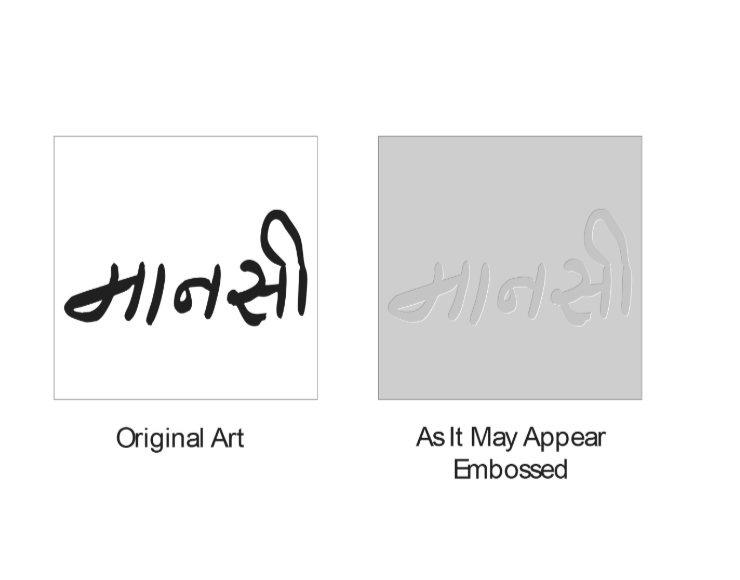
This is my artist's mark. The signature I'll press into every piece of work I make from here on. And for years, I didn't know what that mark should be.
I've watched other artists and noticed how they sign their work. It’s usually confident, assertive and declarative. Something definitive.
Something that says: this came from me, this is mine, this is the shape my name takes when it becomes art.
I’d just settled for my name in cursive—ordinary, functional, and somehow... lacking. But what else was I to do? I tried my initials, clever monograms a scrawl, but none of it felt right.
Then, a few weeks ago, as I was preparing six hand-embellished paintings as gifts for you—my earliest members of Inside the Ripple Studio—my hand moved differently.
I wrote my name in Devanagari script—मानसी—the writing system I learned as a child in India, the alphabet of my first language. But I didn't add the shirorekha—the horizontal bar that traditionally runs across the top of the characters, connecting them into a single bound form.
My hand hovered, then moved. No line to hold it in.
My body exhaled.
It felt right.
I was born in India. I spent the first half of my life there. I carry the lineage—the childhood memories, the way certain foods taste like home, the reflexes of a culture that shaped me before I had language for it. These things are woven into my cells.
But I've also rejected so much of what I inherited. The ways I was raised, the expectations placed on women, the hierarchies and silences and unquestioned traditions—I've examined them, and I've set many of them down.
My daughter's inheritance will be drastically different from mine. She doesn't speak Hindi. She doesn't know Devanagari. When I showed her my new signature, she said it looked like “a dancing script”—hieroglyphics, beautiful but unreadable to her.
For years, I didn't know where I belonged. Not “Indian enough” to feel rooted there. Not “American enough” to feel at home here. I existed in a state of permanent in-between, shaped by one place but living in another, fluent in neither culture completely.
And then somewhere along the way in these past few years, the confusion lifted. I realized I didn't have to pick a side.
This signature—मानसी without the bar—holds that paradox.
It acknowledges the 21 years I spent in India, the language I learned first, the name I was given. It doesn't erase any of that. But the bar—the line that's supposed to be there—is gone. I let it go. Not out of disrespect for tradition, but because I get to decide which traditions I carry forward and which I reshape.
The shirorekha felt like constraint. An expectation of how things should be done. The line you're not supposed to cross.
At 47, I've become who I am not just because of what I was given, but because of what I chose. I can honor my lineage and make my own choices. I can be shaped by where I came from and become something entirely my own. Rootedness and freedom aren't opposites. They can coexist.
Beginning with The Curator's Collection—the limited-edition, hand-embellished art cards I'm launching in 2026—every piece will carry this signature. Not drawn or painted, but pressed into the paper with that embosser arriving tomorrow.
You'll feel it before you see it. The impression of letters without their constraining line. The shape of a name that knows itself.
Tomorrow, when that embosser arrives, I'll hold it in my hand and I'll know: this is permanent now. This is real.
This is the mark I'm making.
Rooted and free. Bound to nothing and no one.
Oh! To be me!
માનસી